
Pakistan has significantly increased the price of high-octane fuel, impacting luxury vehicle owners, while also seeing increases in petrol, diesel, and airline fares due to rising global oil prices.
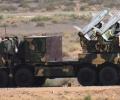
Even as the benchmark and broader indices were down sharply on Monday due to escalating tensions in West Asia, the Nifty Defence index ended the session in the green.

The International Cricket Council (ICC) has cancelled its Board and committee meetings due to the ongoing military conflict in West Asia, according to a report by ESPNcricinfo on Tuesday.
Prime Minister Narendra Modi will hold a video conference with chief ministers of most states to assess their preparedness and strategies in response to the ongoing conflict in West Asia.

Eid al-Fitr was celebrated across India with prayers for peace and brotherhood, alongside protests condemning US-Israel actions in West Asia.

The Islamic Revolutionary Guard Corps (IRGC) has announced a series of military operations against US and Israeli targets in retaliation for earlier airstrikes. The IRGC claims to have launched multiple missile and drone strikes, and has warned against any potential ground operations within Iranian territory.

This weekend, Donald Trump has begun to say the quiet part out loud -- that he wants to take control of Iran's oil, a formulation more in line with his robber-baron style of international relations.

Congress leader Rahul Gandhi has criticised Prime Minister Narendra Modi's foreign policy and his remarks referencing the COVID-19 pandemic in relation to the West Asia situation.

Do not exit in panic or buy falling stocks without reassessing fundamentals; instead, build a watchlist and invest gradually with a disciplined, long-term approach.

Pakistan's Prime Minister Shehbaz Sharif has offered to mediate between the US and Iran to de-escalate the ongoing conflict in West Asia, following a joint US-Israel attack on Iran. Sharif has been in contact with Saudi Arabia, the UAE, and other nations to promote dialogue and diplomacy.
The US has temporarily permitted India to accept Russian oil already on ships to ensure energy supplies amid the conflict with Iran. This short-term measure is not expected to significantly benefit Russia financially.

The Indian government is unlikely to allow a parliamentary debate on the West Asia crisis, citing prior briefings by the External Affairs Minister. This decision comes amid opposition protests and a pending no-confidence motion against the Speaker.

Households should moderate large discretionary expenses for the time being.
'They should prioritise essential spending. They should maintain an emergency fund covering 6 to 12 months of expenses.'
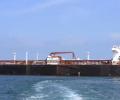
Despite ongoing tensions in West Asia, the successful arrival of the LPG carrier 'Nanda Devi' in Gujarat ensures a steady supply of liquefied petroleum gas to India, highlighting the country's efforts to secure its energy needs.

'Despite the large number of missiles and drones we have already launched, we still possess reserves and missile cities whose doors have not yet been opened,' says Iran's Consul-General Saeid Reza Mosayeb Motlagh.

Amidst ongoing conflict, Iranian President Masoud Pezeshkian signals a potential de-escalation by apologising to neighbouring countries while firmly rejecting US President Donald Trump's demand for unconditional surrender.

The US embassy in Saudi Arabia and the US consulate in Dubai were reportedly targeted by suspected Iranian drone attacks amid heightened tensions in the Middle East following US and Israeli strikes on Iran.

Prime Minister Narendra Modi held a virtual meeting with chief ministers to review preparedness and plans in light of the West Asia conflict, emphasising the importance of national unity and enhanced security measures.

A disruption in the supply of LPG cylinders caused by tensions in the Strait of Hormuz is impacting Indian kitchens, leading to restaurant closures, price hikes and a surge in demand for electric cooktops.

Opposition parties are demanding a full Parliament discussion on the West Asia conflict, criticising the government's silence and calling for a contingency plan to protect India's energy security and citizens.

'The White House lunch that Trump hosted for Munir last year came just after Munir returned from a visit to Iran, at a moment when Israel and Iran were at war.' 'Trump said after that lunch that the Pakistanis know Iran very well. He likely views Munir as a useful interlocutor that can give helpful insights on Iran.'

West Asia conflict triggers sharp sell-off in Indian markets, with realty, banking and auto stocks leading losses amid energy shock fears.
Pakistan's Prime Minister Shehbaz Sharif has engaged in extensive diplomatic efforts to de-escalate the conflict in West Asia, offering to host talks between the US and Iran and engaging with leaders from Saudi Arabia, Qatar, Malaysia, the UK, China, and the European Union.

India restricts subsidised LPG connections for households with piped natural gas (PNG) to ensure equitable distribution and address global energy supply concerns, pushing for faster PNG adoption.

Taking Kharg would give the US control over virtually all of Iran's oil exports and thus provide significant leverage, notes Prem Panicker in his must read daily blog on the Gulf War. It would also put American troops within range of Iran's remaining missiles, drones, and artillery on a piece of real estate that is just eight square miles in size, and just 15 miles from the Iranian mainland.

The US torpedo attack on the Iranian warship IRIS Dena in international waters was a lawful act of war between belligerents, not a diplomatic or strategic embarrassment for India, asserts Vice Admiral Biswajit Dasgupta (retd).

'In such a scenario, Iran could proclaim itself victor, rebuild, re-enforce its diminished regional proxies to further destabilise neighbouring nations and take control of the Persian Gulf and Strait of Hormuz.'

The pause gives the US time to breathe, to regroup, to move its expeditionary force into position without risk of interception along the way. It gives Iran nothing -- on the ground, attacks against its infrastructure continue apace. Prem Panicker in his must read daily blog on the Gulf War.

Trump claims the United States is performing exceptionally well in its ongoing conflict with Iran, citing weakened Iranian military capabilities and a strong US position.

Indian restaurants are grappling with a severe LPG shortage due to the West Asia conflict, forcing them to innovate with menus and cooking methods or face potential closures, impacting the food industry and consumers across the country.

Israel and the United States had a plan. Iran punched back. And now the Gulf is reeling, the world is beginning to feel the pain and, as on date, no one in Washington or Tel Aviv appears willing to admit that the punch has landed, notes Prem Panicker, continuing his must-read blog on the war in the Middle East.

Iran is fighting a different war: Older, slower, and in some ways more dangerous. Iran doesn't need to shoot down an F/A-18. It only needs to make the Strait of Hormuz feel dangerous long enough for insurance markets, shipping companies, and oil futures traders to do the rest. Prem Panicker continues his must-read daily blog on the war in the Middle East.

Union Minister Pralhad Joshi assures that the Indian government is prepared to bring back Indians stranded in the Gulf region due to the Iran-Israel conflict and disruptions in Dubai, emphasizing citizen safety as the top priority.

Oil prices rose following Biden's suggestion that United States and Israeli officials were considering a possible Israeli strike on Iranian oil facilities, as reported by the Washington Post.

The leak occurs at a particularly delicate time in US-Israel relations and is likely to infuriate Israel, which has been preparing to retaliate against Iran following a missile barrage on October 1.
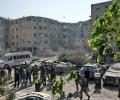
At the end of the day, for many worldwide, the ongoing mutual attacks between Israel and Iran would seem a contest devoid of any moral high ground and only a bout between two ordinary adversaries, one that nevertheless risks spinning out of control into a larger conflagration, notes Shyam G Menon.

Under the deal, Israel would suspend its plans to annex large parts of the occupied West Bank.

The government also wants to ensure that content meant for radicalising youths, from outfits like Islamic State, doesn't find circulation in India.
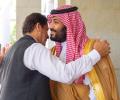
Given all the turbulence created by Pakistan Foreign Minister Qureshi's unexpected tirade against Saudi Arabia, it is likely to be business as usual between the two countries, albeit with a bit of caution on the part of both, observes Lieutenant General Syed Ata Hasnain (retd).
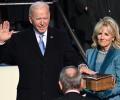
World leaders said they were looking forward to working with Joe Biden, as they welcomed the 46th President of the United States with praise and took parting shots at his predecessor Donald Trump.
